

You Are Putting The Cart Before Horse, We Expect ECI To Respond In Transparent Manner: Apex Court Refuses Interim Order To Suspend CEC Gyanesh Kumar
The Court also issued notice on a PIL challenging decisions and software modifications implemented under CEC Gyanesh Kumar.

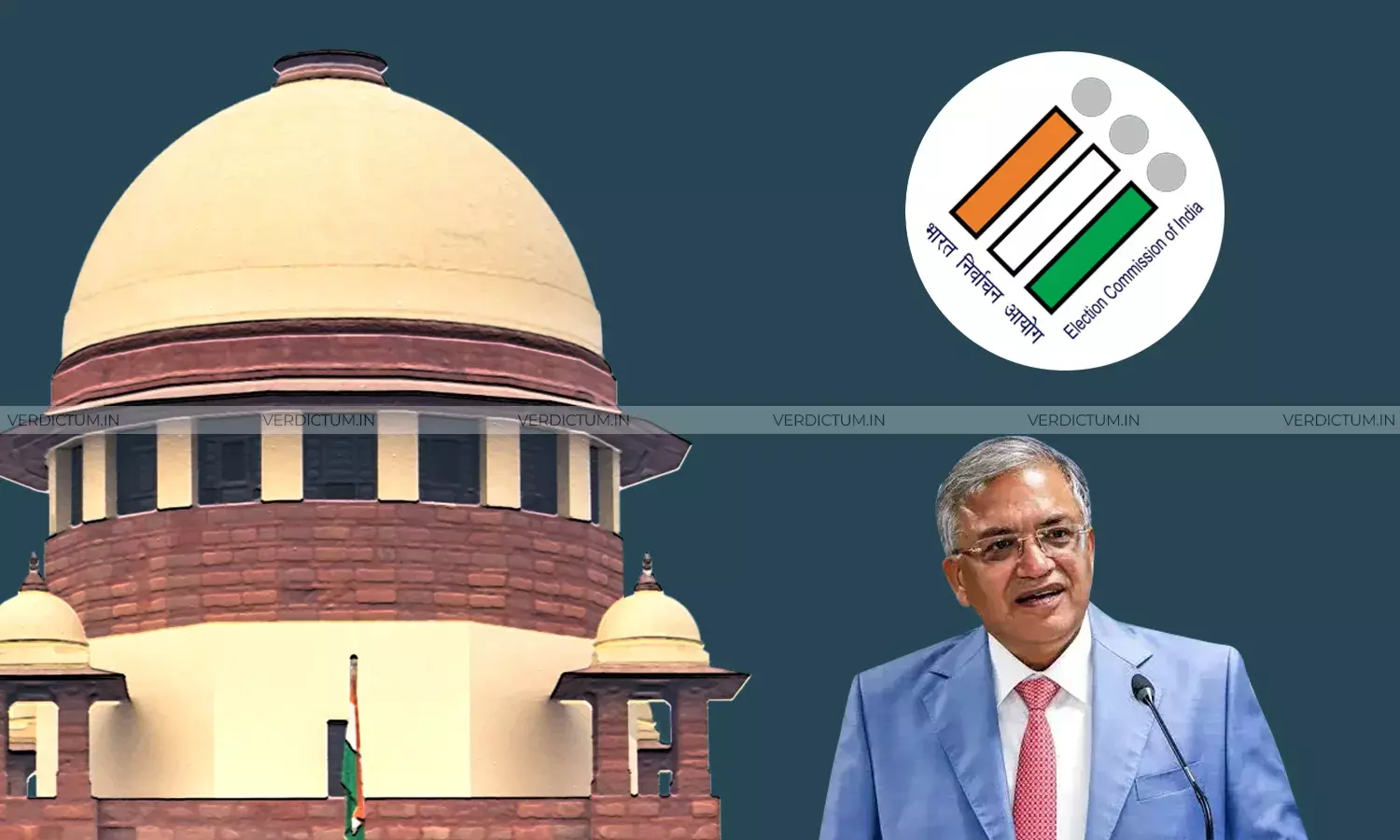
The Supreme Court refused to pass immediate ex-parte interim directions to suspend Chief Election Commissioner Gyanesh Kumar and issued notice to the Union of India, the Election Commission of India, and other respondents.
A Public Interest Litigation (PIL) petition was filed under Article 32 of the Constitution of India, inter alia, seeking directions against all decisions, guidelines, directives, and software modifications initiated, approved, or implemented under Chief Election Commissioner Gyanesh Kumar. One more plea was heard, filed by Rakesh Singh, regarding the same issue.
The Bench of Chief Justice Surya Kant, Justice Joymalya Bagchi and Justice V Mohana, while refusing to pass any interim orders, issued notice in both the matters and sought responses from the Respondents.
Senior Advocates Vikas Singh and Menaka Guruswamy appeared for the Petitioners
As reported by The Indian Express, Election Commissioners Dr Sukhbir Singh Sandhu and Dr Vivek Joshi registered written dissents on record on at least 14 separate occasions over a 10-month period. The objections pertained to administrative decisions and official orders issued without the knowledge, consent, or participation of the full Commission, four of which occurred on a single day.
Singh highlighted the statutory evolution between the 1991 Act (as amended in 1993) and the 2023 Act governing the Election Commission. He submitted that under Section 10 of the former 1991 Act, the procedure for the transaction and allocation of business was required to be decided by a unanimous decision, whereas all general business was to be transacted unanimously as far as possible, failing which it was to be decided by a majority.
He also referred to Section 16 of the Act and said that it exalted the Chief Election Commissioner to a pedestal even higher than Supreme Court judges or other constitutional functionaries.
Singh submitted, "One talks of: has to be as far as the procedure within the Election Commission is concerned, how the procedure will be followed, that has to be unanimous. That is with regard to the working of the Commission. With regard to discharge of its functions under sub-section (2), that can be by unanimity. The distinction is this: the functioning of the Commission."
Chief Justice Kant said, "It can be interpreted like this, because if you see again 18(1): "The Election Commission may, by unanimous decision, regulate the procedure for transaction of business..."
Singh added, "So this is only transaction of business. This is not with regard to its functions...so transaction of business and allocation of work. This has to be unanimous."
He vehemently argued for immediate interim directions to either suspend the Chief Election Commissioner or divest him of his authority to act as such, suggesting that the two Election Commissioners should temporarily conduct the upcoming elections.
He submitted that the Chief Election Commissioner was acting in direct contravention of the statutory mandate laid down under Section 18 of the 2023 Act by taking unilateral decisions without the requisite majority or unanimity, particularly regarding the revision of electoral rolls.
Alternatively, he prayed for an interim order directing that all decisions taken by the Election Commission in the interim period must strictly be made by unanimity or at least by a majority as prescribed by law, arguing that any vitiated electoral process could not be undone post-elections.
Singh said, "I am requesting an interim order today to suspend the CEC immediately. I'll tell your Lordships why: because of what is happening today—there are elections happening. No, my Lord, it will have to be done, or divest him—divest him of the authority to act as CEC. I am saying, my Lord, restore the Anoop Baranwal position...We are dealing with a very grave situation today—a grave situation which can undermine the very basis of our democracy. Today, our democracy is vibrant and known all over the world because of the way we are able to conduct our elections. Now, this election, which has been conducted for 76 years with the Election Commission having a certain amount of respect, where, as far as his personal involvement in the electoral process is concerned, has never been questioned."
The Bench observed that a statutory protection for acts done in office was well-recognized and noted that the challenge to the constitutional validity (vires) of Section 16 was already pending before a larger Bench in a connected matter. Addressing the prayer for interim relief, the Bench declined to pass ex-parte orders or presume statutory violations based solely on unverified newspaper reports or press releases.
The Court said, "You are putting the cart before the horse. Without notice, can we expect—come to a decision that all the decisions were unilateral?...Systemic position will respond to the notice, and we expect them to respond in a clear, transparent manner."
Ultimately, the Court issued notice to the respondents, including Respondent No. 3 (Election Commission of India), as well as Respondents 5 to 8, directing them to file their responses.
In another plea, filed by Shailendra Mani Tripathi, who sought directions to quash the alleged unauthorized modifications made to Form 6 on the ECINet/ERONet, Guruswamy submitted that provisions of the Representation of the People Act, 1950 (RPA) as well as the newly enacted Chief Election Commissioner (CEC) Act were infringed during the conduct of the Summary Intensive Revision (SIR).
Chief Justice Kant said, "At least confine your issues, some of the issues, (to) either common issues."
Guruswamy further highlighted that in Delhi, two unauthorized conditions were added to Form 6, despite Form 6 being prescribed under the Schedule to the RPA and thus set in stone. She asserted that the functioning of the Chief Election Commissioner was biased and protected by an unconstitutional statutory framework, maintaining that free and fair elections were under severe threat.
The Bench observed that the pleadings and documents annexed to the writ petition were jumbled and contained disparate, state-specific prayers, pointing out that Prayer 'B' pertained specifically to Delhi whereas Prayer 'C' related exclusively to West Bengal. The Court remarked that instead of multiple fragmented prayers, a single comprehensive prayer seeking the annulment of any exercise conducted unauthorizedly or in violation of statutory provisions would have sufficed.
As regards the matter concerning West Bengal SIR, it was stated in the plea that when Appellate Tribunals presided over by retired High Court judges heard appeals against wrongful exclusions, between 90% and 93% of deleted voters were restored, establishing the reckless, arbitrary, and legally flawed nature of the Commission's initial purges.
The plea was filed against the Ministry of Law & Justice, the Election Commission of India, CEC Gyanesh Kumar, the Cabinet Secretary and others.
It highlighted that the investigative report demonstrates that Election Commissioners Dr Sukhbir Singh Sandhu and Dr Vivek Joshi repeatedly recorded written dissents and formal objections on at least 14 occasions across 10 months (from November 2025 to August 2026) against actions executed by the CEC and senior bureaucrats. For over four months (May to September 2026), no formal full-Commission meeting was convened, and orders were issued unilaterally without circulated agendas or post-meeting minutes.
It was alleged that on July 29, 2026, Election Commissioners Sandhu and Joshi took the unprecedented step of formally petitioning Cabinet Secretary T.V. Somanathan, terming Garg's action a "clear violation of Section 18" of the 2023 Act and demanding strict disciplinary action. It is added that on July 30, 2026, Commissioners Sandhu and Joshi jointly nullified and quashed Garg's order.
Cause Title: Rakesh Kumar Singh@ Rakesh Singh v. Union of India [W.P.(C) No. 1204 of 2024] and Shailendra Mani Tripathi v. Union of India and Ors. [Diary No. 59734/2026]